Hydro jetting cleans a drain or sewer line with high-pressure water instead of a cable. We run a jetter hose through a cleanout. The nozzle on the end scours the full pipe wall and flushes the debris downstream. Call (313) 474-7729, 8 AM to 10:30 PM, every day.
How it works
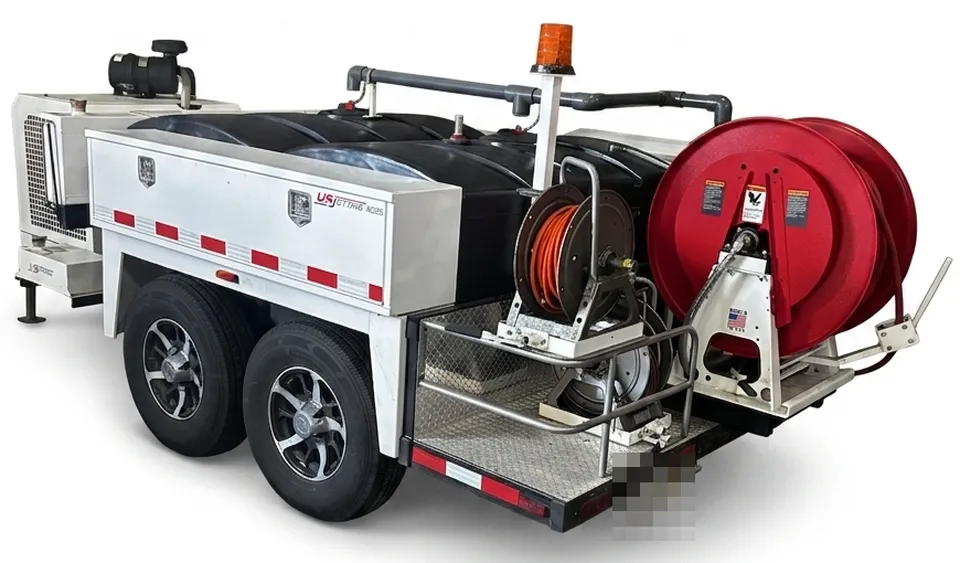
- Jetter: a pump that pushes water through a flexible hose at high pressure (PSI) and a set flow (GPM). Pressure does the cutting. Flow carries the debris away. Ours is a trailer-mounted US Jetting 4025, rated up to 4,000 PSI and 25 GPM.
- Nozzle: rear-facing jets pull the hose up the line and flush debris back. Forward jets break up the blockage.
- Access: we go in through a cleanout, ideally working against the flow.
Light-duty residential jetting runs at about 1,500–2,500 PSI on 2- to 4-inch lines. Commercial jetting commonly runs at 2,500–4,000 PSI. We set the pressure and nozzle for the pipe material and condition, not the maximum the machine can do.
Nozzle types
- Penetrating (chisel) nozzle: forward jets to open a hard stoppage.
- Rotating nozzle: spins 360° to strip grease and light roots off the pipe wall. This is the usual choice for maintenance cleaning.
- Root-cutting nozzle: cuts root masses at the joints.
- Chain or cutter heads: reserved for hard scale and buildup, and only after a camera check.
Jetting vs. snaking
A snake (cable machine or auger) punches a hole through a clog. That gets water moving fast, but grease and root hairs stay on the pipe wall, and the clog tends to come back. Jetting cleans the wall itself, removing:
- Grease and FOG (fats, oils and grease)
- Soap scum and sludge
- Sediment and sand
- Scale on cast iron
- Root masses and the fine root hairs that regrow
We still snake when that's the right tool, for example a single fixture clog or a pipe too fragile to jet.
Camera before and after
Before jetting an older line, we run a sewer camera to check the material, condition, joints and what the blockage actually is. That sets the pressure and nozzle. A second camera pass afterward confirms the line is clean and shows any defect the debris was hiding. You see what we see.
When we won't jet
Pipe condition matters more than pipe age. Sound vitrified clay and sound cast iron handle jetting well. We don't jet, or we use lower pressure and a different tool, when the camera shows:
- A collapsed or crushed section
- Cracked or offset clay joints, or missing pieces
- Thin cast iron, or channel rot (the bottom of the pipe worn through)
- Orangeburg (tar-paper fiber) pipe, which softens and deforms with age
Water forced through a break can wash out the soil around the pipe. A broken line needs sewer line repair, not cleaning.
Maintenance jetting: quarterly or every 6 months
For many customers, we recommend scheduled jetting every three or six months instead of waiting for the next backup. Cleaning the line before buildup closes it off keeps it flowing. It's for:
- Restaurants and commercial kitchens. Grease builds up fast. Kitchens with moderate frying commonly start at quarterly. Lighter-grease operations often hold at twice a year, and heavy-fryer kitchens may need it more often. We schedule around service hours and your grease trap pump-out.
- Homes with recurring backups. If the floor drain backs up every few months, a set schedule beats emergency calls.
- Lines with tree roots. Roots come back through the same joints. Regular jetting keeps them cut back before they block the line.
- Older Detroit sewers. Most Detroit homes were built before 1960, with cast-iron drains and clay laterals that collect scale, grease and roots.
- Rentals and multi-unit buildings, where one main line serves several households.
The right interval depends on what's going down the drain and what the camera finds. We set it from your line's history and adjust it as we go.
Frequently asked questions
Is hydro jetting safe for old pipes?
On sound pipe, yes, with the right pressure and nozzle. That's why we camera older lines first. Collapsed, cracked, badly corroded or Orangeburg pipe shouldn't be jetted.
Is hydro jetting better than snaking?
For grease, scale, sludge and roots, jetting cleans the whole pipe wall, while a snake opens a path through the clog. For a single fixture clog or fragile pipe, a snake can be the better tool.
How often should a line be jetted?
Many of our customers do it quarterly or every six months. Restaurants and lines with roots or recurring backups are usually on the shorter interval.
Do you need a cleanout?
Yes. We jet through a cleanout. If your house doesn't have an accessible one, we'll tell you the options.